Launch a website in a week: six assets UK small businesses must have

Yes, you can get a genuinely good website in a week, but only if one thing is true before day one: you have your assets ready and one person calling the shots. Skip that condition and a week turns into a month of email tennis. The fastest routes are a fixed‑scope sprint or a productised, subscription‑style build, both of which strip out the faffing about that usually eats the calendar.
TL;DR:
- A one-week website build is feasible only with all assets prepared beforehand and a single decision-maker in charge of final approvals.
- Fixed scope projects like 48-hour sprints or subscription models work best for small, straightforward sites such as event pages or local business profiles.
- Major delays often stem from slow feedback, missing content, or access issues, not technical complexity, emphasizing the importance of upfront logistics.
- Custom functionalities like booking systems or multi-language setups typically require more time and cannot be compressed into a week without cut corners.
- Clear goals, a defined page list, brand files, draft copy, and ready-to-go host/login details are critical for a smooth, on-schedule build.
Table of Contents
- What does “website in a week” actually mean?
- Is it realistic to build something good in a week?
- Who actually benefits from a week-long build?
- What do you actually gain from the sprint approach?
- The six things you need ready before anyone starts building
- What actually happens each day of a build week?
- What fits in a week, and what does it cost?
- Sample page lists and copy prompts to speed things up
- Why most one-week timelines actually fail (and how BasicBS avoids it)
- The advice nobody wants to hear about fast websites
- Get your site live this week with BasicBS
- Sources
- FAQ
What does “website in a week” actually mean?
Three different things get lumped under this phrase, and mixing them up is where a lot of disappointment starts.
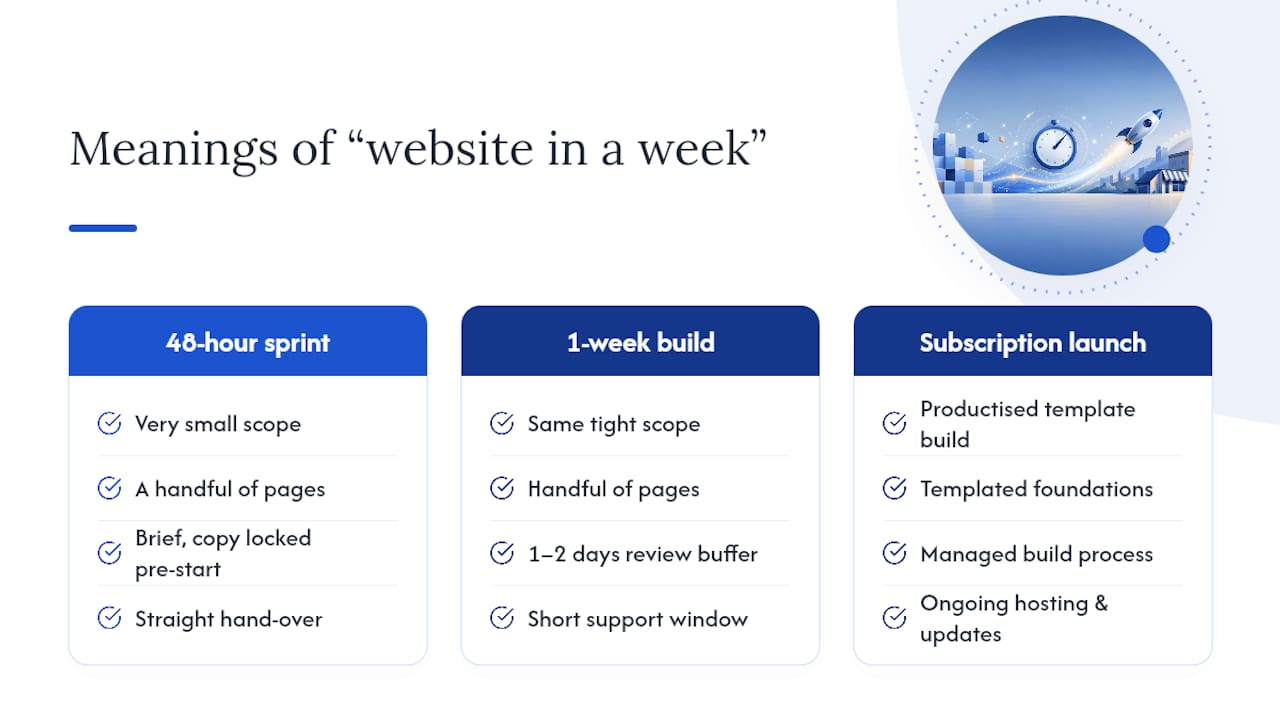
The first is the fixed 48-hour sprint: an intense, compressed build where the brief, copy and visual direction are locked before the clock even starts. This works well for a small number of pages marketing sites, because there’s simply not enough surface area for scope to sprawl. The second is the one-week build with buffer: the same tight scope, but with a day or two of slack for reviews, DNS propagation, or the inevitable “actually, can we change the logo colour” moment. The third is the productised or subscription launch, where a business signs onto a monthly plan with templated foundations and a managed build process, rather than commissioning a one-off project from scratch.
Each model delivers different things. A sprint typically gets you a handful of pages, basic on-page SEO, and a straight handover. A subscription model tends to add ongoing hosting, updates and support as part of the monthly cost, which suits businesses that don’t want a “finished” website so much as a website that keeps working for them. Where any of these models struggle is custom functionality: booking systems, bespoke databases, or third-party integrations that need their own testing time. Bolt those on and you’re no longer looking at a week. You’re looking at a proper project.
Is it realistic to build something good in a week?
It’s realistic, but only when the usual culprits behind late websites get dealt with upfront. Most delays come from three places: content that isn’t written yet, review loops with too many opinions in them, and domain or hosting access that nobody can find the login for. None of these are design problems. They’re logistics problems, and logistics problems are entirely avoidable.
A frozen brief and a pre-agreed design system are what make the difference between a smooth week and a stalled one. When the scope is locked and nobody’s adding “just one more page” on day three, a builder can move through pages at pace because every decision was already made before the work began. Compare two real scenarios: one client sends a finished Word document with all their copy, a vector logo, and tells one manager to approve everything, the site launches on schedule. Another client has three co-owners each giving different feedback on the homepage colour scheme, and that same week quietly becomes three. Delays caused by slow feedback and missing content are common enough that naming a single decision-maker before the sprint starts is one of the cheapest insurance policies you can take out on your own timeline.
Who actually benefits from a week-long build?
This model is brilliant for some projects and a bad fit for others, and knowing which camp you’re in saves everyone a headache.
Good fits:
- Event websites (weddings, parties, one-off launches) with a fixed date and limited page count
- Small brochure sites for local businesses that need a professional presence, not a web app
- Founder-led launches where one person owns every decision and just wants to get live
Poor fits:
- Large e-commerce catalogues with hundreds of products needing individual descriptions and images
- Multi-language sites requiring translated copy and locale-specific structure
- Anything needing a custom backend, bespoke booking logic, or heavy third-party API work
If you’ve got a single decision-maker and clear windows in your diary for quick reviews, you’re in good shape. If your website needs sign-off from a committee, or if “we’ll figure out the content as we go” is your current plan, a week is the wrong ambition for now.
What do you actually gain from the sprint approach?
Speed is the obvious win, but it’s not the only one, and it’s arguably not even the most valuable one.
Getting live fast means you start learning fast. A site that’s up in a week gets real visitor behaviour, real enquiries, and real feedback within days rather than months, which means you can adjust based on what’s actually happening rather than what you assumed would happen. There’s also a scope benefit that’s easy to underrate: because everything has to be decided before the sprint begins, you end up with far fewer meetings. No drawn-out design review cycles, no “let’s circle back next week” limbo. And when the scope is fixed from the outset, the price tends to be fixed too, which means no surprise invoices creeping in as “small extras” get added along the way.
The six things you need ready before anyone starts building
This is the bit that actually determines whether your week goes smoothly or turns into a slog. Before a sprint can start, you need six specific assets sat ready to hand over, not half-finished in someone’s head.
- A specific, measurable goal. Not “get more customers” but “generate 10 enquiries a month through a contact form.” A clear primary goal becomes the tiebreaker for every small decision made during the build.
- A defined target audience. Who is this site actually talking to? A wedding site for guests reads nothing like a trade site for commercial buyers.
- A finished page list. Home, About, Services, Contact… know exactly what you need before anyone opens a design tool.
- Vector logo files and brand guidelines. A PNG dragged off your old website won’t cut it. You need proper vector files (AI, EPS or SVG) and, ideally, your brand colours and fonts written down somewhere.
- Draft copy for key pages. It doesn’t need to be polished, but it needs to exist. Waiting on copy is the single biggest cause of blown timelines.
- Domain, hosting and account access. Whoever’s building needs the logins now, not on day four when DNS changes are urgent.
If any of these are missing, don’t panic, just delegate fast. Ask a colleague to draft rough copy while you sort brand assets, or use a simple template structure (goal, audience, one paragraph per page) to get something workable in an afternoon rather than a week.
Pro Tip: Write your homepage copy as bullet points first, then turn them into sentences later. It’s far quicker than staring at a blank page trying to sound “professional” from word one.
What actually happens each day of a build week?
Here’s the reality of a five-day build, assuming your pre-work is genuinely done before day one. This isn’t a rough guide, it’s the actual mechanics of how a sprint moves.
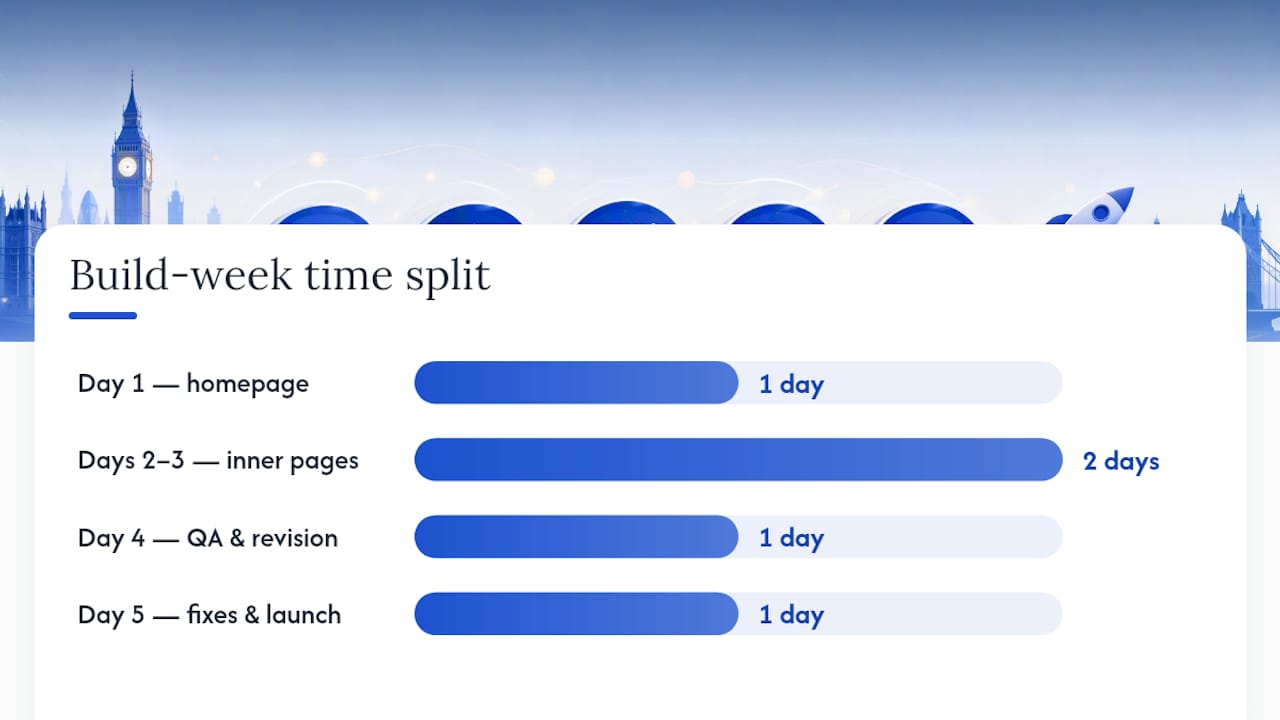
Before Day 1: the freeze. Nothing starts until the brief is locked, the six assets above are handed over, and one decision-maker is named. This is non-negotiable. Standard small-business web projects typically span several weeks when discovery, planning and design run as separate phases. A one-week build only works because that planning and design decision-making happens before the clock starts, not during it.
Day 1: homepage and structure. The homepage hero, navigation and overall site structure (the information architecture) get built and sent for approval. This is the day that sets the tone for everything else, so the client review here needs to happen fast, ideally within a few hours, not a few days.
- Deliverable by end of day: homepage draft live on a staging link, ready for sign-off.
- Client task: approve or request changes within the agreed window (commonly same-day).
Day 2 and 3: inner pages and responsive build. With the homepage approved, the remaining pages (Services, About, Contact, whatever’s on the agreed page list) get built out using the same design system. This is also when the responsive pass happens, checking how everything looks and behaves on mobile and tablet.
- Deliverable by end of Day 3: full site structure built and viewable, desktop and mobile.
- Client task: minimal, mostly staying available for quick questions rather than full reviews.
Day 4: quality assurance and one revision round. Every page gets checked for broken links, spelling, load speed and cross-browser quirks. The client gets one numbered revision list, not an open-ended “let us know your thoughts” invitation.
- Deliverable by end of day: a numbered list of proposed fixes, submitted for one round of client feedback.
- Client task: respond with numbered replies against that list (this single habit saves more time than almost anything else in the whole process).
Day 5: fixes, DNS, launch. Final tweaks from the revision round get made, domain records get pointed at the new hosting, and the site goes live. Handover documentation, login details and a short walkthrough usually happen here too.
- Deliverable by end of day: live website, DNS resolved, handover complete.
The fast-review rule that makes all of this work is simple: one decision-maker, numbered feedback lists instead of vague comments, and fixed response windows agreed before the sprint starts. A tight review process with short windows and structured lists is consistently what separates sprints that land on schedule from the ones that quietly slip.
What fits in a week, and what does it cost?
Scope, not ambition, is what determines whether a build fits into a week. Here’s roughly what different page counts realistically include:
| Build size | Typical pages | What’s usually included |
|---|---|---|
| 3-page | Home, About, Contact | Basic SEO setup, mobile responsive, contact form |
| 5-page | Home, About, Services, Gallery, Contact | As above, plus more detailed service breakdowns |
| 8-page | Home, About, multiple Services, Blog landing, Gallery, Contact, FAQ | As above, plus a content structure ready for ongoing blog updates |
Anything beyond this scope tends to push a project past the one-week mark. Custom integrations (booking systems, payment gateways with bespoke logic, CRM syncing), multilingual sites needing separate translated structures, and large product catalogues all introduce testing and content demands that simply don’t compress into five days without cutting corners somewhere.
Pricing in this space is usually tied to the deliverable rather than the hours worked, which is worth checking against any quote you receive. If a vendor’s price swings wildly based on your “brief complexity” rather than the number of pages and features you’re asking for, that’s a sign the scope isn’t actually fixed, whatever they’re calling it.
Sample page lists and copy prompts to speed things up
Borrow these structures directly. Having a starting page list ready cuts hours off the brief stage alone.
- 3-page brochure site: Home / About / Contact
- 5-page small business site: Home / About / Services / Gallery / Contact
- Event site (wedding, party, one-off): Home / Our Story / Details & Timings / RSVP / Gift Registry
For copy, a simple prompt structure gets a usable first draft fast: for your homepage hero, write one sentence saying what you do, one sentence saying who it’s for, and one clear call to action. For a services page, list each service with a one-line benefit rather than a feature description. For contact, keep it to your preferred method, your response time, and your service area.
Accept a template when your business is straightforward and speed matters more than uniqueness, an event site or a simple local trade business, for instance. Ask for custom design when your brand identity is doing real commercial work for you, a boutique, a studio, anything where “looking like everyone else” would actually cost you customers.
Why most one-week timelines actually fail (and how BasicBS avoids it)
The pitfall we see most often isn’t a design problem, it’s a decision-making problem. Three people giving three different opinions on a homepage headline will sink a week-long build faster than any technical issue ever could. That’s why every sprint we run starts with one thing agreed before anything else: who’s making the final call.
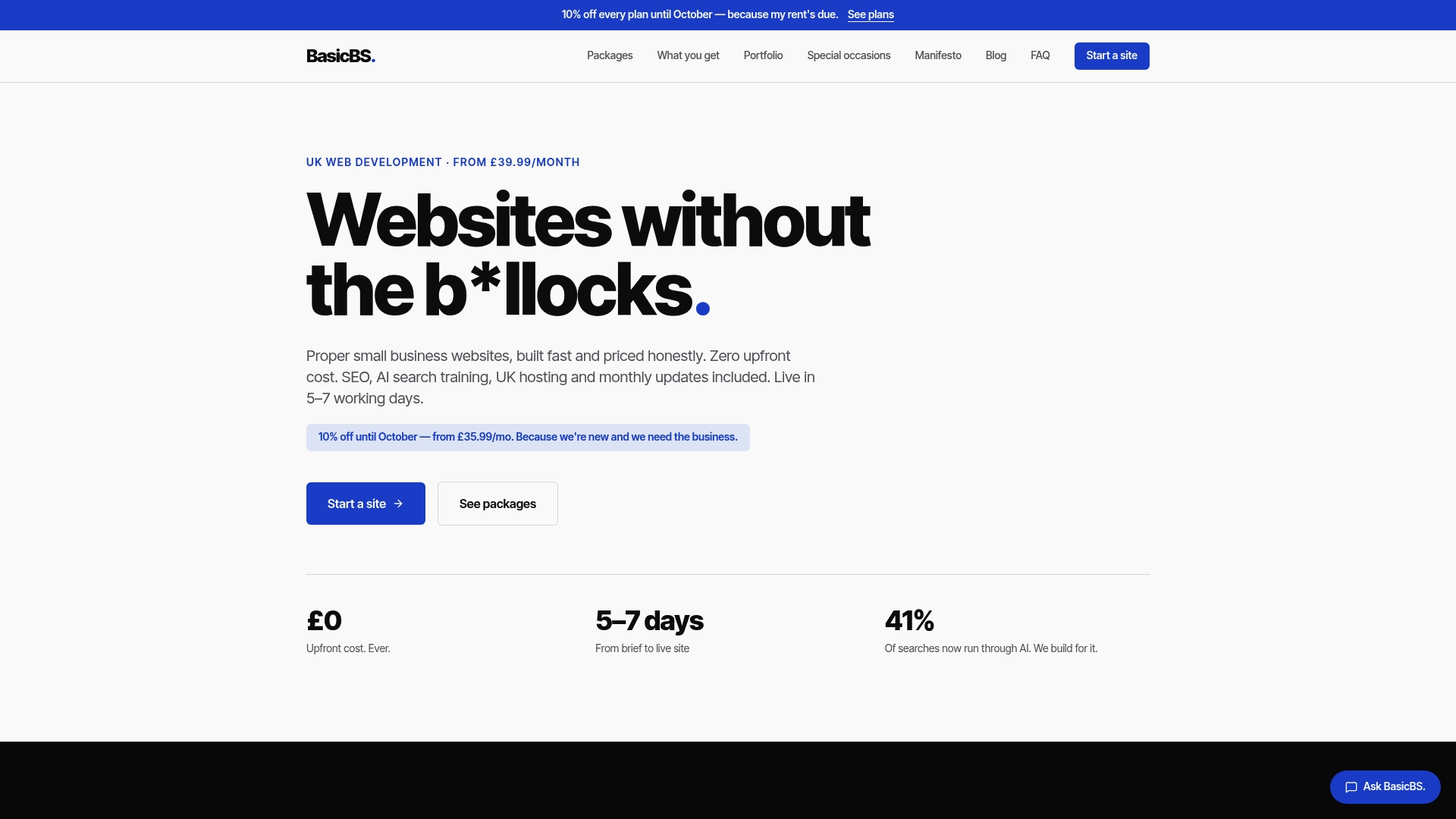
BasicBS plans start from an affordable monthly subscription fee, with zero upfront cost and a turnaround of a few working days once the brief is locked. Every site we build also gets AI training baked in from the start, meaning it’s structured to be found by AI-driven search tools, not just traditional search engines, giving small businesses a fighting chance in a market that’s shifting fast.
[Author professional background details to be inserted] [Case studies or client testimonials specific to Conor to be inserted]
The advice nobody wants to hear about fast websites
Most guides on building a website quickly focus entirely on the build itself, the tools, the templates, the tech stack. That’s the wrong end of the problem. The actual bottleneck, almost every single time, is decision-making speed on the client side, not build speed on the developer’s side.
The conventional wisdom says “hire a fast developer.” The better advice is “become a fast decider.” A single named decision-maker with a locked brief will out-perform a brilliant designer working against a committee, every time, because indecision doesn’t show up as a line item, it shows up as three extra weeks nobody budgeted for.
If you take one thing from this article, prioritise your pre-work over your provider search. A mediocre builder with a locked brief and ready assets will beat a brilliant one working from vague instructions and half-written copy. Get your six assets sorted first. The rest follows far more easily than people expect.
— Conor
Get your site live this week with BasicBS
This service is a straightforward alternative to a lengthy agency process for anyone who needs a site live now, not in eight weeks. The process cuts the rubbish around endless discovery calls and drawn-out sign-off chains, and builds against a fixed brief with a 5 to 7 working-day turnaround, starting from a monthly subscription fee with zero upfront cost.
Before you get in touch, have your goal, page list, logo files and draft copy ready, it genuinely is the difference between a smooth week and a stretched one. Sites built also come with AI training baked in, so they are set up to be found by AI-driven search tools as well as traditional ones, helping clients to compete in search visibility. Take a look through our example builds and templates to see the kind of scope that fits comfortably into a week, or head straight to our plans and pricing to book your brief and get a live date confirmed.
Sources
- 48-Hour Website Build: Step-by-Step Process | Onyxarro
- How to Brief a Web Designer (2026 Guide + Free Template) | Parabolic Studio
FAQ
What are the 7 C’s of a website?
Definitions vary slightly by source, but the concept generally covers clarity, consistency, credibility, content, communication, customisation and conversion, the pillars that make a site both usable and effective.
Is web design still in demand?
Yes, demand remains strong as small businesses increasingly need fast, AI-search-optimised sites rather than static brochures, which is exactly why rapid, productised builds like those from Basic-bs have grown in popularity.
How many hours does it take to make a good website?
It depends entirely on scope, but a focused 3 to 8 page site built against a locked brief and frozen design system can realistically go from start to live within a five-day working week.
How do I get more visitors to my new website quickly?
Consistent local SEO, sharing your site across existing customer channels, and ensuring your site is structured for both traditional and AI-driven search all help, tools that track your local search performance after launch, such as a dedicated rank tracker, can show you what’s working.
What’s the biggest reason one-week website projects fail?
Slow client feedback and unfinished content, not technical delays, cause most missed deadlines, which is why naming one decision-maker and preparing your assets before the sprint starts matters more than which builder you choose.