Live in 5–7 Days: Landing Page vs Website for UK SMEs
Use a landing page when you need one action from one type of visitor, fast; build a website when people need to discover you, trust you, and find several reasons to buy. Most small businesses need both eventually. A landing page wins your next campaign; a website wins your next five years.
TL;DR:
- Landing pages typically convert campaign traffic at a median rate higher than full website pages due to their focused design and message match.
- Removing navigation and reducing content can roughly double conversion rates, especially when speed and simplicity are prioritized.
- Smaller businesses should start with a single, targeted landing page for short-term promotions and switch to a structured website as their offerings grow or long-term SEO becomes important.
- A full website with proper structure supports multiple entry points, longer-term growth, and discovery, but requires a higher budget and more development time.
- Quick, transparent website or landing page creation services can deliver effective assets within one week with minimal upfront cost, ideal for short-term campaigns or small-scale projects.
Table of Contents
- Landing page vs website: the quick definition that trips people up
- What a proper small-business website needs to do
- Landing page vs website: the side-by-side breakdown
- How to decide: a five-minute checklist before you build anything
- Do you need a website if you already have landing pages?
- Practical tips by business type: trades, events, ecommerce and creatives
- How BasicBS builds landing pages and websites quickly and transparently
- Examples of successful landing pages and websites, by industry
- Common tools and platforms to create landing pages versus websites
- Measurement and analytics differences for landing pages vs websites
- Author viewpoint: pick the smallest asset that does the job
- Get a website or landing page live in a week, not a quarter
- Sources
- FAQ
Landing page vs website: the quick definition that trips people up
A landing page is a single, standalone page built to do one job: convert one specific slice of traffic into a lead, a sale, or a booking. There’s no menu, no “About Us” link, no distractions. It exists to answer one question and push toward one action.
A website is different by design. It’s a whole collection of linked pages built to serve people who arrive for all sorts of reasons: some want your prices, some want proof you’re legit, some are just nosing around before they commit to anything.
That’s the difference between a landing page and a homepage in one sentence: a homepage is the front door to a whole building; a landing page is a single room built for a single conversation.
What actually makes a landing page work
The best landing pages share a stubborn focus. Every element earns its place because it either builds trust or nudges the visitor toward the CTA. Nothing else survives.
- Message match: the headline echoes whatever the ad, email or link promised. Break that promise and visitors bounce within seconds.
- One primary call to action, repeated (not buried), so there’s never a moment of “what am I meant to do here?”
- A short form. Every extra field you ask for costs you conversions, so only ask what you genuinely need.
- Social proof and trust signals: a review, a logo, a guarantee, anything that answers “can I trust this business?” without the visitor having to dig.
- A hero image or short video that shows the outcome, not just the product.
Technically, speed matters more than people think. A slow landing page doesn’t just lose visitors, it actively pushes up what you pay for the traffic that gets there, because page speed and landing experience feed directly into ad auction metrics like Quality Score. Tracking pixels and basic A/B testing aren’t optional extras either. If you’re not testing headlines and CTAs, you’re guessing.
Pro Tip: Before you build anything, strip your draft page of navigation entirely. If a visitor can click away to five other pages, you haven’t built a landing page, you’ve built a distraction with a form on it.
Quick wins if you’re editing an existing page: remove the main menu, cut your copy by a third, repeat the CTA above and below the fold, and check the whole thing on a phone before anything else. Marketing tools such as AWeber commonly bundle a landing page builder in with email marketing, which is often the fastest, cheapest route in if you’re testing an offer for the first time.
What a proper small-business website needs to do
A website’s job is different, and bigger. It has to work for the person who found you on Google at 11pm, the one your mate referred by name, and the one who’s compared you against three competitors already. That’s a lot more than one page can handle.
Most small businesses genuinely need only a handful of pages to start:
- Homepage: sets the tone, states what you do, points visitors where to go next.
- About: this is where trust gets built, particularly for trades and services where people are letting a stranger into their home or business.
- Services: specific enough that visitors self-select before they even call.
- Contact: a real phone number, a real form, and ideally a map if you’re local.
- Testimonials or case studies: proof, not adjectives.
- Blog or resource pages: this is what feeds long-term SEO and gives Google a reason to keep sending you traffic months after the initial launch.
- Ecommerce or booking, if that’s how you actually take money.
A website with proper structure supports multiple entry points for different search intents, which is precisely what a single landing page can’t do. It’s the difference between someone finding your “emergency boiler repair” page directly from Google and someone landing on a page that also shows them your reviews, your other services, and your area coverage.
Underneath all of it sit the basics that too many cheap builds get wrong: proper hosting, an SSL certificate, a content management system you can actually update yourself, and full mobile responsiveness. None of that is glamorous. All of it is the difference between a site that keeps working and one that quietly breaks six months in.
Start lean. A five-page site with clean copy beats a bloated twelve-page site with thin content every time. Add blog posts and service pages as you go, once you know what your customers actually ask about.
Landing page vs website: the side-by-side breakdown
Here’s where the two genuinely diverge, and why picking the wrong one for the job costs you money.
| Factor | Landing page | Website |
|---|---|---|
| Number of pages | One | Multiple, linked |
| Navigation | None or minimal | Full menu |
| Primary goal | One conversion action | Discovery, trust, multiple journeys |
| Calls to action | Single, repeated | Several, varied by page |
| Time to launch | Hours to a couple of days | Days to a few weeks |
| Cost | Low, often bundled with marketing tools | Higher, ongoing |
| SEO potential | Low, usually temporary | High, compounds over time |
The behavioural logic behind that conversion gap is worth understanding, not just accepting. Every navigation link on a page is an exit ramp. Fewer exits mean fewer distractions, and a visitor who arrived expecting one specific thing is far more likely to complete it if that’s the only door in the room.
The numbers behind it: removing navigation from a landing page has been shown to roughly double conversion rates in some case studies, and dedicated landing pages tend to convert at a higher median rate for campaign traffic than general website pages precisely because of that tighter message match.
There’s a paid-traffic angle too, and it’s one a lot of small business owners miss until they’ve overspent on ads. Google and Meta both score your landing experience as part of the ad auction. A slow, cluttered page doesn’t just convert worse, it makes every click more expensive. Speed and focus aren’t just design choices; they’re a cost lever.
How to decide: a five-minute checklist before you build anything
Work through this before you brief a developer, not after you’ve paid for a build you didn’t need.
- Where’s the traffic coming from? Paid ads, a single email campaign, or a QR code on a flyer means you almost certainly want a landing page.
- How long does this need to live? A four-week promotion doesn’t need a full site rebuild. A business that’ll still exist in three years does.
- How many things are you actually selling? One offer, one landing page. Five services across three towns, you need a website with proper structure.
- What’s your budget shaped like? A landing page can be live for the cost of a single tool subscription. A website is a bigger, ongoing commitment, and that’s fine if it’s the right tool.
- How will you know if it worked? If you can’t answer this, stop and fix your tracking before you commission anything.
If your traffic is a mix of ongoing search plus the odd campaign, the honest answer is usually both: a proper website as your base, with dedicated landing pages spun up for each specific push.
Pro Tip: Before you commission anything from a developer or agency, ask them directly: “What happens to this page after the campaign ends, and what does it cost me to keep it live?” If they can’t answer clearly, that tells you something about how they price their work.
Testing advice that gets skipped constantly: use a cheap, fast landing page to validate a new offer before you sink money into a full website build around it. Prove the demand first. Build the permanent structure once you know it’s worth building.
Do you need a website if you already have landing pages?
Sometimes, genuinely, no. If you run one offer, sell one thing, and your business has a natural end date (a seasonal event, a single product launch, a short-term campaign), a landing page can carry the whole business on its own.
But most small businesses outgrow that fast:
- If people refer you by name and then go looking for you, they’ll expect to find more than one page.
- If you offer more than one service, a single landing page will always feel like it’s hiding something.
- If organic search matters to you at all, a landing page alone won’t get you there. Websites need broader structure for organic visibility in a way a single page simply can’t replicate.
- If you’re selling multiple products, you need proper product and category pages, not one page trying to do everything.
The risk of staying landing-page-only past that point is invisible until it isn’t: you lose every visitor who wanted to browse, compare, or check you out before buying. Migrating later isn’t hard, but it’s easier to plan for from day one.
Practical tips by business type: trades, events, ecommerce and creatives
Trades and local services (plumbers, electricians, joiners): start with a mobile-friendly quote page as your core landing asset, one clear CTA, local schema so you show up properly in local search, and use dedicated landing pages for seasonal promotions like boiler servicing or gutter clearing. A plumber website design package or an electrician-focused build should include exactly this from day one, not as an upsell later.
Special events (weddings, baby showers, birthdays): a one-page event site, often password-protected for guest-only details, works better than a full website nobody else needs to see. Add a short RSVP landing page if you need to track numbers separately.
Ecommerce: you need proper product pages, categories and a working checkout, full stop. There’s no shortcut here. Landing pages still earn their place for specific product launches or seasonal sales, but they sit alongside the site, never instead of it.
Portfolios and creatives: a full site builds the trust and discovery that gets you found in the first place. Landing pages come in for specific commission windows or ticketed events, where you want one focused push rather than a browsing experience.
How BasicBS builds landing pages and websites quickly and transparently
Speed and honesty are the whole point. Most agencies stretch a build over weeks of “discovery workshops” before you’ve even seen a design. BasicBS doesn’t work that way.
- Sites go live within about a week, whether it’s a full website or a focused landing page.
- Managed hosting with SSL included as standard.
- AI search training and SEMrush-led SEO built in, so you’re set up for both traditional search and how people now query things on AI platforms.
- Transparent monthly pricing, with loyalty discounts for returning clients.
For a single campaign or a short-term promotion, BasicBS will usually point you towards a focused landing page. For anything with more than one service, or any ambition to be found on Google in six months, a proper website is the better spend.
Examples of successful landing pages and websites, by industry
The pattern repeats across industries once you know what to look for. A tradesperson running a summer boiler service promotion gets far more bookings from a single, focused landing page with one phone number and one CTA than from burying the same offer three clicks deep on a full site. The page works precisely because there’s nowhere else to go.
Contrast that with a local joinery business building long-term reputation. Their homepage, gallery of past work, and a page of genuine reviews do the heavy lifting over months, not days, pulling in searches for “bespoke kitchen joiner” long after any single ad campaign has ended.
Event sites follow the same logic in miniature. A hen do or wedding site succeeds by doing one thing cleanly: showing the details, collecting RSVPs, and disappearing once the day’s done. Nobody needs a navigation menu for their own wedding invite.
Ecommerce examples split the difference. The category and checkout pages do the daily work of running the shop, while a single seasonal landing page (a Black Friday push, a new product drop) captures a short burst of paid traffic without cluttering the main site’s structure. Each format is doing the job it’s actually suited to, not the job that’s easiest to build.
Common tools and platforms to create landing pages versus websites
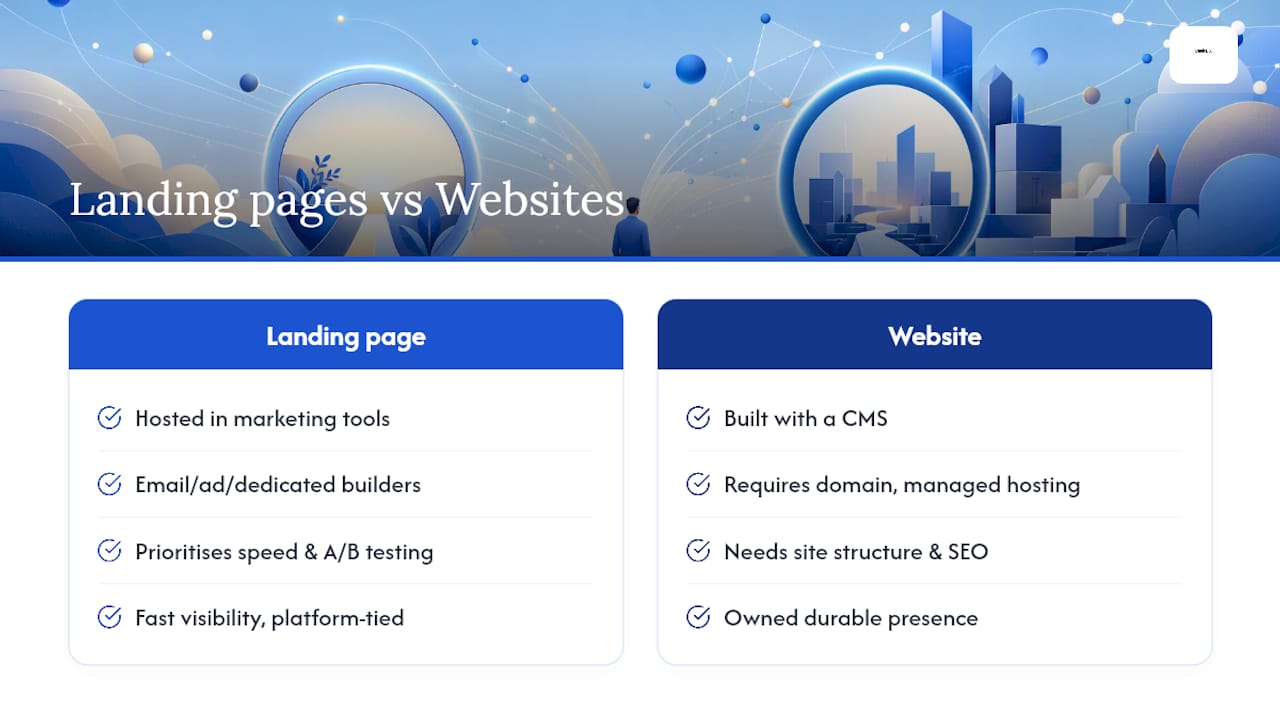
Landing pages tend to live inside marketing tools rather than standalone builders. Email platforms like AWeber bundle a landing page builder directly into the marketing tool, which makes sense: you’re already managing the campaign there, so the page that supports it lives in the same place. Ad platforms and dedicated landing page tools work the same way, prioritising speed of launch and built-in A/B testing over depth of structure.
Full websites are a different build entirely. They typically need a proper content management system, a domain, managed hosting, and someone thinking about site structure and SEO from the outset rather than bolting it on afterwards. This is where the gap between DIY builders and a managed service shows up most clearly for small businesses without in-house technical skills.
If you’re weighing up a fast do-it-yourself landing page against a solution that lets visitors ask questions directly that’s actually yours to control, the trade-off is usually time versus ownership. A marketplace listing gets you visibility fast but ties you to someone else’s platform and someone else’s fees. A landing page or website you own gives you the harder-won but more durable result: a customer relationship in local search that doesn’t disappear if a directory changes its algorithm.
Tools like AI-driven marketing platforms are increasingly used to help test and optimise landing page copy and targeting before a page ever goes live, which is worth exploring if you’re running frequent campaigns rather than a single one-off push.
Measurement and analytics differences for landing pages vs websites
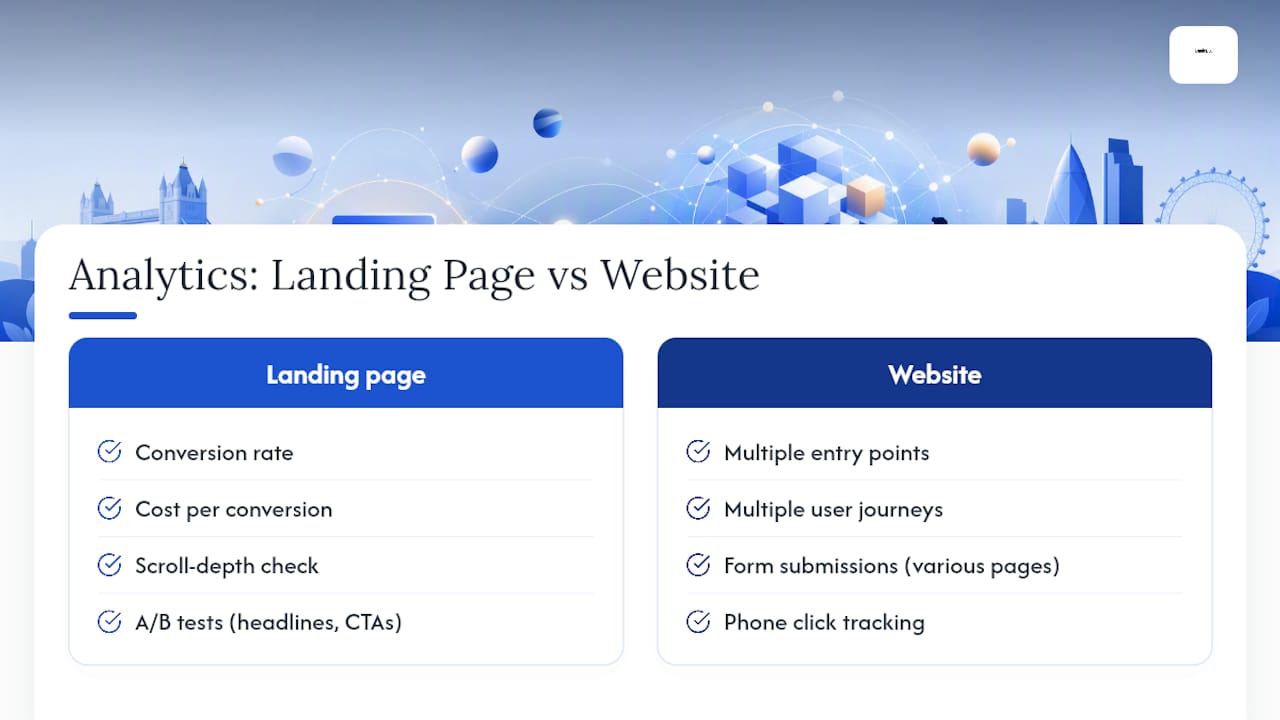
Measuring a landing page is refreshingly simple, and that’s the point. You’re tracking one conversion goal, so your analytics setup can stay narrow: conversion rate, cost per conversion, and maybe a scroll-depth check to see if visitors are reading the page at all. A/B testing headlines and CTAs is straightforward because there’s only one path through the page to test.
Website analytics get more layered, by necessity. You’re tracking multiple entry points, multiple user journeys, and multiple goals at once: form submissions on one page, phone clicks on another, blog engagement feeding organic search over months rather than days. Tools like Google Analytics and Search Console become essential here, not optional, because a website’s value shows up gradually across dozens of small signals rather than one clean conversion number.
The practical takeaway: don’t judge a website by landing-page metrics, and don’t judge a landing page by website metrics. A website that’s slowly building organic traffic over six months might look flat on a weekly report and still be doing exactly what it’s meant to do.
Author viewpoint: pick the smallest asset that does the job
Here’s the rule we’d give any small business owner asking this question: build the smallest asset that actually fulfils your current goal, and plan for a website the moment long-term discovery starts to matter. Don’t build a twelve-page site for a single four-week promotion, and don’t try to run a growing local business off one landing page forever.
Measure everything, even the small stuff, because the data tells you when you’ve outgrown whichever asset you started with. And if you’re looking at pay monthly websites for small business rather than a five-figure agency invoice, ask exactly what’s included before you sign anything. Transparent pricing shouldn’t be the unusual option.
— Rhys
Get a website or landing page live in a week, not a quarter
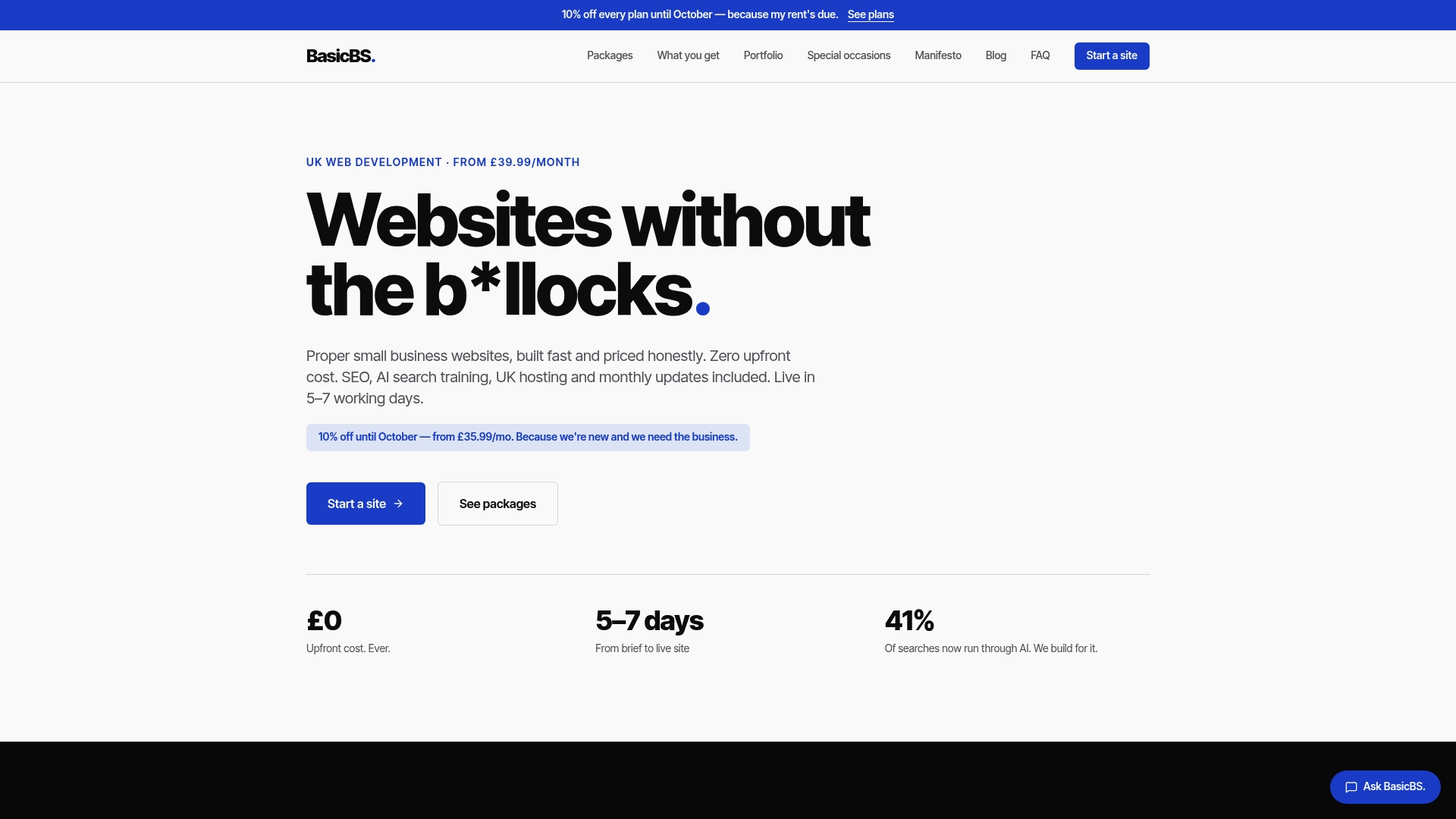
BasicBS is the alternative to the traditional agency model for anyone comparing a landing page against a full website: no eye-watering upfront quote, no months of workshops before you see a design, and no hidden charges buried in a renewal email. Instead, you get a working site or focused landing page live in 5 to 7 working days, with a one-off setup fee from £100 and the Website Sale! plan from £10 a month covering managed UK hosting, SSL, monthly updates, AI search training and SEMrush-led SEO.
This isn’t website design with a monthly contract that traps you. Whether you need a simple website for sole traders, a mobile-friendly quote page for trades, or a bespoke one-page event site from £99.99 for a wedding or baby shower, the build fits the goal rather than forcing every client into the same twelve-page template.
If you’re running a business across Burnley, Pendle or anywhere else in the UK and want to know exactly what a proper build costs before you commit to anything, check BasicBS’s full website design and hosting services and get a straight answer, not a sales call.
Sources
- Do You Need a Website or a Landing Page? A Decision Guide for Paid Traffic | Leadpages Blog
- Landing page vs website: what’s the difference? | HubSpot Blog
- Landing pages vs. websites: How to know when to use each one (plus examples) | Webflow Blog
- Landing page vs website: which one does your business need? | AWeber
FAQ
Do I need a website if I have a landing page?
Not always, but usually yes once you offer more than one thing or want to be found on Google beyond a single campaign. A landing page alone works fine for a single, time-limited offer; anything with ongoing services or multiple products needs the broader structure a proper website provides.
Can a landing page be a website?
Technically a single landing page can function as your only online presence, particularly for one-offer businesses or short-term events, but it won’t support the discovery, SEO and multiple customer journeys a full website handles. Think of it as a website’s little sibling: capable of one job, not built for everything.
Are landing pages still worth using?
Yes, and arguably more than ever for paid campaigns. Dedicated landing pages still convert at a higher median rate for campaign traffic than general website pages, largely because of tighter message match and fewer distractions.
How do I create a landing page?
Most small businesses build a landing page using a marketing tool with a built-in page builder, or commission a fast, focused build from a web designer. BasicBS builds landing pages and full websites alike within 5 to 7 working days, with pricing available on the BasicBS services page.
How much does a landing page or website cost with BasicBS?
BasicBS’s Website Sale! plan starts from £10 a month, alongside a one-off setup fee from £100, with no hidden charges added later. Full current pricing for event sites and add-ons is listed on the BasicBS website.