3 question decision flow: .co.uk vs .com for UK small businesses
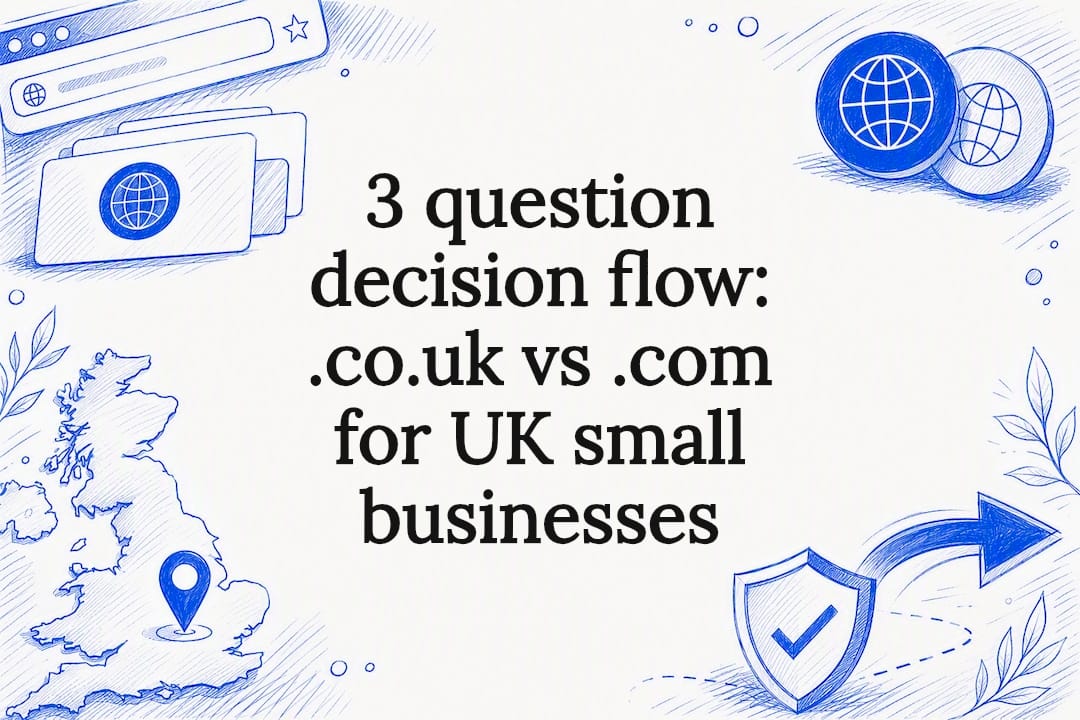
For most UK businesses, .co.uk is the right primary domain. It signals “we’re local, we’re legitimate, we’re here” the second someone spots it in search results. The exception is if you’re building something genuinely global from day one, chasing international investors, or selling to customers who couldn’t care less which country you’re based in. Either way, register both and redirect the one you’re not using. It costs next to nothing and saves you a headache later.
TL;DR:
- Registering a .co.uk or .uk domain boosts trust and local relevance for UK customers, especially in trades, retail, and hospitality sectors.
- A .com domain can rank well in the UK if properly configured with search settings, hreflang tags, UK hosting, and local backlinks.
- Costs for .co.uk and .uk domains typically range from £5 to £15 annually, with premium .com names often resold at high prices.
- For international growth, register both .co.uk and .com, redirect the latter to the primary domain, and verify both in Google Search Console.
- Focus on website trust factors like UK hosting, SSL, UK-specific reviews, and clear GBP pricing to maximize customer confidence regardless of domain choice.
Table of Contents
- .co.uk vs .com: the quick comparison
- How domain choice affects your Google visibility in the UK
- Does .co.uk actually make customers trust you more?
- What does a .co.uk domain actually cost in the UK?
- A simple decision flow for choosing your domain
- Registering both domains without wrecking your SEO
- Hosting, SSL and the small details that affect UK visitors
- How Basic-bs helps UK businesses get this right
- Our honest take on the domain debate
- Get your domain and website sorted properly
- Sources
.co.uk vs .com: the quick comparison
Here’s the bit most people actually want: a straight, no-faff comparison of what each ending gives you and what it costs.
.co.uk is a country-code domain (a ccTLD), which means it tells search engines and humans alike “this business operates in the UK.” It’s usually available for less than a .com equivalent because fewer people are fighting over UK-specific names, and it builds trust fast with British buyers who’ve been burned by dodgy overseas sellers before.
.com is a generic domain (a gTLD) with no country signal baked in. It’s the world’s default, which is exactly why decent short names are almost always gone or being resold at eye-watering prices.
.uk is the newer, punchier cousin of .co.uk. Same local trust signal, fewer characters, growing adoption.
- Geographic signal: .co.uk and .uk shout “British business”; .com says nothing about location on its own.
- Cost and availability: .co.uk and .uk tend to be cheaper and easier to snag; good .com names are often taken or sold at a premium.
- Trust with local customers: .co.uk and .uk win here, especially for anyone who’s ever Googled “is this company even in the UK”.
- When .uk makes sense: if the .co.uk you want is gone but the shorter .uk version is free, grab it. Same local credibility, less clutter in your URL.
How domain choice affects your Google visibility in the UK
Google reads .co.uk and .uk as strong hints that your site is aimed at British searchers. That’s what a ccTLD does: it’s a built-in geographic flag, no extra setup required. A .com, on the other hand, is geographically neutral by default, so Google has to work out your target market from other clues.
This matters most for local and near-me style searches. Someone searching “plumber near me” or “wedding photographer Leeds” is far more likely to see UK-relevant results pushed up the rankings when your domain already carries that geographic signal. Search Engine Journal has reported that Google treats ccTLDs as a meaningful geotargeting signal, while gTLDs like .com need to earn that same local relevance through other means.
That doesn’t mean a .com is doomed in UK search. It just needs help:
- Set your target country manually in Google Search Console (this tells Google explicitly who you’re trying to reach).
- Use hreflang tags if you run multiple regional versions of your site, so Google knows which version to serve to which audience.
- Host on UK-based servers where possible, since server location is a minor but real supporting signal.
- Get UK-specific citations, reviews, and local backlinks to reinforce the geographic story your domain alone can’t tell.
Statistic callout: Moz’s research into ccTLD performance found that a properly configured .com can still rank well for local queries. The ccTLD advantage is real but modest. It’s a head start, not a finish line. As GoDaddy’s own guidance points out, content relevance and overall site quality still do the heavy lifting in how well any site ranks, whatever its ending.
Does .co.uk actually make customers trust you more?
Short answer: yes, and it’s not just vibes. British shoppers have spent years getting stung by dodgy overseas retailers, dropship scams, and websites that looked legitimate right up until the order never arrived. A .co.uk or .uk ending is a small but noticeable signal that you’re operating under UK consumer law, pricing in pounds, and answerable to someone local if things go wrong.
That trust premium isn’t evenly spread across every industry. It matters most where customers are handing over money for something they can’t inspect first, or where “who am I actually dealing with” is a live worry:
- Trades (plumbers, electricians, builders) — customers want to know you’ll turn up, and a local domain reads as more accountable than a generic one.
- Retail and e-commerce — GBP pricing and a .co.uk address together cut down the “will this even ship to me” hesitation.
- Hospitality — hotels, restaurants, and event venues benefit from looking rooted in a specific place, not a faceless global brand.
If your heart’s set on a .com, you can still narrow the trust gap. Show a UK address and phone number prominently, price everything in GBP rather than dollars, and display genuine UK customer reviews near the point of purchase.
Pro Tip: If you’re stuck between a great .com and a mediocre .co.uk, don’t assume the .com automatically wins on trust. Test both names on a handful of actual UK customers first. Gut reactions to a domain name are more telling than you’d expect.
What does a .co.uk domain actually cost in the UK?
Registration costs are genuinely low across the board, so price shouldn’t be the deciding factor unless you’re chasing a specific premium name.
- .co.uk: typically £5 to £15 a year from most UK registrars, sometimes less as a first-year promotional rate.
- .uk: similar pricing to .co.uk, often bundled together by registrars since Nominet manages both.
- .com: usually £8 to £20 a year for a fresh, unclaimed name, but that’s a different world entirely from resale prices.
The real cost trap is the secondary “premium” or resale market. A short, memorable .com that’s already registered can be relisted for hundreds or thousands of pounds through domain marketplaces, and there’s no cap on what a seller can ask.
When you check availability through a domain lookup tool such as WhatsMyDNS, “taken” doesn’t always mean someone’s actively using the name. It sometimes means it’s sitting in a reseller’s portfolio waiting for a buyer with more money than sense. Read the result carefully: a name flagged as premium is negotiable, just not free.
A simple decision flow for choosing your domain
Cut through the dithering with three questions and a clear path for each answer.
- Are almost all your customers based in the UK? If yes, register .co.uk (or .uk if the shorter version is free) as your primary domain. Set it live, point your hosting at it, and build your site content around it from day one.
- Are you building a product or service aimed at a genuinely international market, or courting overseas investment? If yes, .com is the sensible primary choice. Register it, then configure Search Console with your intended target country and add hreflang tags if you’ll run separate regional pages later.
- Are you UK-focused now but might expand internationally down the line? Register .co.uk as your primary domain and buy the matching .com at the same time, purely for brand protection. Point the .com at your .co.uk with a 301 redirect so nobody typing the wrong ending lands on a dead page or, worse, a competitor who snapped it up first.
Whichever outcome fits, the implementation steps are the same three jobs: register the domain(s), set your redirects correctly, and verify both in Google Search Console so you’re not flying blind on performance data.
Pro Tip: Don’t leave the “protection” domain parked and forgotten. Check it once a year to confirm the redirect still works and the registration hasn’t lapsed. Domains do get accidentally dropped, and someone else can register your old name within days.
Registering both domains without wrecking your SEO
Registrar guidance consistently recommends buying both your .co.uk and .com even when you’ll only actively use one. It’s cheap insurance against a competitor, a scammer, or an overseas seller registering the other version of your brand name and causing confusion.
The redirect setup matters more than people assume:
- Point the domain you’re not using as your primary at the primary one with a 301 redirect (a permanent redirect), never a 302. A 301 tells search engines this is a permanent move, so any authority the old domain has passes across properly.
- If you’re migrating an established site from one domain to another rather than just holding a spare, use canonical tags to confirm the preferred version, resubmit your sitemap, and monitor Search Console closely for a few weeks afterwards.
- Update every DNS record tied to the domain you’re moving away from, particularly MX records for email, before you switch anything live.
Statistic callout: Registrars including 20i note that brand protection through dual registration is now standard advice, not a nice-to-have for cautious business owners.
On email: keep it simple. If you’re redirecting a domain, don’t leave old email addresses live on it unless you genuinely still check them. Update your signatures, your invoices, and your Google Business Profile at the same time you switch domains, so customers aren’t left guessing which address actually reaches you.
Hosting, SSL and the small details that affect UK visitors
Domain choice isn’t the only technical decision that shapes how your site performs for British visitors. A few smaller details matter more than people expect.
- Hosting location: servers based in the UK typically shave a small amount off load times for UK visitors, and they reinforce the “we’re local” signal alongside a .co.uk domain.
- SSL certificates: non-negotiable regardless of your ending. Browsers flag sites without one, and customers bounce the instant they see a warning.
- Cookie banners and GDPR: UK data protection rules apply whatever domain you’re on, .co.uk, .uk, or .com. Get your cookie consent and privacy policy sorted before launch, not after a complaint.
- Email deliverability: keep your sending domain consistent with your website domain. Mismatched or newly switched domains can trip spam filters until they build up a sending reputation.
None of this is glamorous. All of it quietly decides whether visitors trust you enough to stick around.
How Basic-bs helps UK businesses get this right
We’ve had this exact conversation with more small business owners than we can count: “Should I get the .com or the .co.uk?” Our honest answer is nearly always .co.uk first, for the reasons covered above, with the .com registered alongside it for protection. That’s not a script. It’s just what tends to serve UK-first businesses best.
Domain sourcing and registration is part of what we sort for clients as standard, alongside UK hosting, SEO groundwork, and AI search training so your new site is built to be found, not just built to look nice. Sites go live in 5 to 7 working days, with plans starting from £39.99 a month and zero upfront fees. No lengthy setup, no hidden charges buried in the small print.
If you want to see what that actually looks like once it’s live, our portfolio has real examples of the work.
Our honest take on the domain debate
Most of the domain advice floating around online treats .co.uk versus .com as a philosophical branding decision. It isn’t. It’s a practical one, and the practical answer for the overwhelming majority of UK small businesses is boringly simple: get the .co.uk, redirect the .com, get on with running your business.
Where the conventional advice falls short is the endless hand wringing over “brand perception” as though picking a domain ending is make or break. It isn’t the ending that builds trust. It’s what’s behind it: fast load times, clear pricing in pounds, a real UK address, and a site that doesn’t look like it was knocked together in an afternoon. The domain is a signal, not a substitute for actually being trustworthy.
If you’re a sole trader worrying over .co.uk versus .com for three weeks while your actual website sits unfinished, you’ve got your priorities backwards. Register the sensible option, point the spare domain at it, and spend your remaining energy on the site itself.
— Conor
Get your domain and website sorted properly
There are other routes to sorting your domain, plenty of registrars will happily sell you a name and leave you to figure out hosting, SSL, and SEO on your own. Basic-bs does the whole job in one go: domain sourcing and transfer, managed UK hosting with SSL, AI search training so newer search tools can actually find you, and monthly updates that keep the site working long after launch.
Transparent pricing with no upfront fees, and your site live within a few working days. That’s a real turnaround, not a “we’ll be in touch” promise. Whether you’re set on .co.uk, weighing up .uk, or need someone to talk you through which one actually fits your business, get in touch with Basic-bs and we’ll get your domain and site sorted properly, without the corporate runaround.
Sources
- What you need to know before choosing a .com, .co.uk or other tlds
- Search Engine Journal — Google hints at ccTLD signals
- Moz blog — ccTLD domain study
- 20i — .com or .co.uk?