Get AI search optimisation results in 4–8 weeks for UK marketers
AI search optimisation means structuring and proving your content so ChatGPT, Google’s AI Overviews, and Perplexity can lift it and cite it, not just index it. That’s a different job to traditional SEO, which optimises for ranking positions. The single highest-impact first step: check that your key answers sit in indexable HTML, which Google’s official guidance confirms AI crawlers can actually fetch. Every client site is built with that access as standard, not an add-on.
TL;DR:
- Ensuring your key answers are in indexable HTML and that your site is crawlable and properly structured is essential for AI citation visibility.
- Focus on writing question-based headings with immediate, clear answers to improve content extraction by AI systems.
- Technical accessibility, such as server-side rendering and correct schema markup, directly impacts whether AI crawlers can read your content effectively.
- Brand mentions, especially in reputable media and directories, are becoming more influential for AI citation than backlinks alone.
- Optimizing multimedia with descriptive alt text, transcripts, and proper filenames helps AI systems accurately interpret visual content.
Table of Contents
- What is AI search optimisation, really?
- How do you structure content so AI can extract it?
- Is your site technically accessible to AI crawlers?
- Do brand mentions matter more than backlinks now?
- How do you actually measure AI search visibility?
- Your 4 to 8 week AI search optimisation checklist
- How do different AI search algorithms interpret content?
- How do intent and personalisation change AI-driven results?
- Why does voice search still matter for AI optimisation?
- Why does semantic SEO matter more in an AI-first search world?
- How should you optimise images and video for AI search?
- Where is AI search technology heading next?
- How does Basic-bs put AI search optimisation into practice?
- Get a website built to be found by AI, not just Google
- Sources
What is AI search optimisation, really?
Right, let’s cut the rubbish. Most agencies will sell you “AI SEO” as some mystical new discipline requiring a total rebuild. It isn’t. AI search optimisation is the practice of making your content extractable, verifiable, and machine-readable enough that a generative system can pull a fact from your page, trust it, and quote it back to a user with your name attached.
Traditional SEO chases a blue link in position one. AI search optimisation chases the citation itself, whether that citation appears in an AI Overview, a ChatGPT answer, or a Perplexity summary. The mechanics overlap more than the marketing suggests, and Google’s own guidance confirms that foundational SEO practices still apply. A page has to be indexable and eligible for standard Search before it stands any chance of being pulled into a generative feature.
That’s why we keep coming back to the basics whenever a client asks us to “get on ChatGPT”. You don’t get on ChatGPT by gaming a secret algorithm. You get there by being the clearest, most trustworthy source the model can find when it goes looking for an answer.
Here’s what that means in practice:
- Your title, meta description, and H1 must say the same thing, in plain language, because AI systems use these as clarity signals.
- Crawlability comes first. No amount of clever writing helps if the crawler can’t reach the page.
- Sitemaps still matter. Submit them properly rather than relying on a stray
llms.txtfile, which most major AI systems simply ignore. - Prioritise decision-stage pages first. Pricing, service, and comparison pages get cited far more often than generic blog filler, because they contain the concrete facts assistants are hunting for.
Skip the vanity pages. Fix the ones that answer a buyer’s actual question.
How do you structure content so AI can extract it?
Write your headings as the questions people actually type or say, then answer them immediately underneath, in one or two sentences, before you elaborate. That single habit does more for citation odds than almost anything else on this list, because it hands the assistant a ready-made passage it doesn’t need to reconstruct from scattered paragraphs.
Every section should stand on its own two feet. Assistants select passages, not whole articles, so if your answer only makes sense after reading three paragraphs above it, it won’t get lifted. Microsoft Ads’ guidance on AI search answers points to exactly this: content built for retrieval systems needs to work as a self-contained unit, because that’s how retrieval-augmented generation actually pulls information.
Here’s a simple sequence to follow when rewriting a page:
- Turn your subheading into the exact question a reader would ask.
- Answer it in the first sentence, in plain terms, no throat-clearing.
- Expand with detail, examples, or nuance in the sentences that follow.
- Use a list or table only when the content is genuinely list-shaped, such as steps or comparisons.
- Add schema markup (FAQ, Article, Product) where it accurately labels what’s on the page, not as decoration.
Keep list items short and complete in themselves. A bullet that says “Faster” tells an AI system nothing; a bullet that says “Pages load in under two seconds on mobile” gives it something to quote.
Pro Tip: Read your own subheading aloud, then read only the sentence directly beneath it. If that single sentence doesn’t answer the question on its own, an AI system won’t be able to use it either.
Is your site technically accessible to AI crawlers?
Most major AI crawlers, including GPTBot and Google’s own AI systems, struggle with JavaScript-rendered content in ways that traditional Googlebot mostly worked around years ago. If your key facts only appear after a script runs in the browser, plenty of AI crawlers never see them at all.
Server-side rendering or prerendering solves this by sending fully-formed HTML on the first request, no script execution required. That’s not a nice-to-have for AI visibility, it’s the difference between being invisible and being citable.
Run these checks before anything else:
- View your page source (not the rendered DOM) and confirm your key answers appear in the raw HTML.
- Check
robots.txtfor accidental blocks on GPTBot, Google-Extended, or other AI user-agents. - Submit sitemaps to both Google Search Console and Bing Webmaster Tools, since several AI systems draw on Bing’s index.
- Review your server logs for recent GPTBot or Bingbot fetches. If they’re absent, detailed crawler diagnostics suggest testing with a server-rendered preview to rule out a blocking issue.
Industry writeups on AI crawling behaviour consistently note that most of these bots don’t execute JavaScript at all, which makes this the single most common technical failure point we see on client sites before we touch them. It’s rarely the content that’s the problem. It’s what the crawler never gets to read.
Do brand mentions matter more than backlinks now?
For AI citation, often yes. Backlinks still carry weight for traditional ranking, but assistants lean heavily on how frequently and how consistently your brand gets mentioned across the web, even in mentions that carry no link at all. Industry data on AI visibility shows brand mentions correlate with AI citation more strongly than raw backlink counts, because unlinked mentions still help a model associate your name with a topic.
That shifts where you spend effort. Chase these instead of another round of guest posts:
- Genuine PR coverage in trade press or local news, where your name sits next to the topic you want to be known for.
- Listings in relevant directories, especially ones with editorial standards rather than paid inclusion.
- Contributions to expert roundups, where a journalist quotes you by name alongside a specific claim.
- Original research or data you publish yourself, since named statistics with dates and sources get referenced far more than opinion pieces.
Vague claims don’t survive this environment. “We’re the best in the business” gives an assistant nothing to verify. “We delivered multiple sites recently, each live within about a week” gives it a fact.
Pro Tip: Every time you publish a statistic, attach the date it was measured and the source. Assistants weigh recency and traceability far more heavily than the number itself.
How do you actually measure AI search visibility?
Search Console shows you what happens in Google’s ecosystem. It tells you nothing about what ChatGPT or Perplexity say about your brand, so you need a wider framework built on three layers: whether AI crawlers can reach your pages, how often you get cited, and how favourably your brand gets described when you do.
The first layer is diagnostic. Log files and rendering previews tell you whether GPTBot and similar crawlers are actually visiting. The second and third layers need dedicated tools, since no single free dashboard covers them yet.
Track these where you can:
- Crawl frequency and success rate from GPTBot, Google-Extended, and Bingbot in your server logs.
- Citation frequency: how often your brand or content gets referenced across AI platforms for your target queries.
- Share of model: your visibility relative to competitors on the same prompts, a metric Adobe’s analysis of AI search infrastructure treats as a core reporting figure alongside AI-sourced referral traffic.
- Assisted conversions: sales or enquiries that trace back to an AI referral, even indirectly.
Tools like Semrush’s AI search visibility checker and Bing Webmaster Tools give you a starting point for the second layer. Report on all three monthly, and tie the numbers back to enquiries or sales, otherwise it’s just an interesting dashboard with no bearing on the business.
Your 4 to 8 week AI search optimisation checklist
Here’s the order we’d tackle this in, based on what actually moves the needle fastest:
- Fix crawlability first: check
robots.txt, submit sitemaps to Google and Bing, confirm no AI user-agent is blocked. - Test rendering: view raw HTML source on your top ten pages and confirm your key facts aren’t hidden behind JavaScript.
- Rewrite your five most valuable pages with question headings and immediate one-sentence answers.
- Add FAQ or Article schema where it genuinely matches the page content.
- Add a visible “last updated” date to every page you touch, since freshness signals matter to generative systems.
- Pursue two or three earned mentions (press, directories, roundups) in the first eight weeks.
- Run a prompt simulation: ask ChatGPT and Perplexity your target questions and check whether you’re cited.
- Iterate on whichever pages didn’t get cited, tightening the answer and checking technical access again.
| Priority | Action | Expected timeframe |
|---|---|---|
| High | Fix crawlability and rendering | Week 1 |
| High | Rewrite top pages with direct answers | Weeks 2 to 3 |
| Medium | Add schema and “last updated” dates | Weeks 3 to 4 |
| Medium | Pursue earned mentions | Weeks 4 to 8 |
| Ongoing | Prompt-test and iterate | Weeks 6 to 8 |
How do different AI search algorithms interpret content?
Not every AI system reads your page the same way. Google’s AI Overviews largely build on the same indexing pipeline as standard Search, layering a generative summary on top of pages already eligible to rank. ChatGPT’s browsing and search features work differently, often relying on retrieval-augmented generation to pull live snippets rather than a pre-built index of your entire site. Perplexity behaves more like a research assistant, favouring pages with clear citations and recent publication dates because it’s built to show its sources openly.
This matters because a page optimised purely for Google’s traditional ranking signals might still get skipped by a retrieval-based system if it can’t be chunked into a clean, standalone passage. Search Engine Land’s research on AI SEO points out that the barrier to citation for smaller sites is rarely domain authority. It’s usually content structure, technical accessibility, and whether the facts on the page are verifiable at a glance.
The practical takeaway: build for extraction generally rather than gaming one platform’s quirks. A page with a clear question heading, an immediate answer, named facts, and clean HTML tends to perform across Google’s AI features, ChatGPT, and Perplexity alike, because all three are ultimately hunting for the same thing: a confident, checkable answer they can lift without editing.
How do intent and personalisation change AI-driven results?
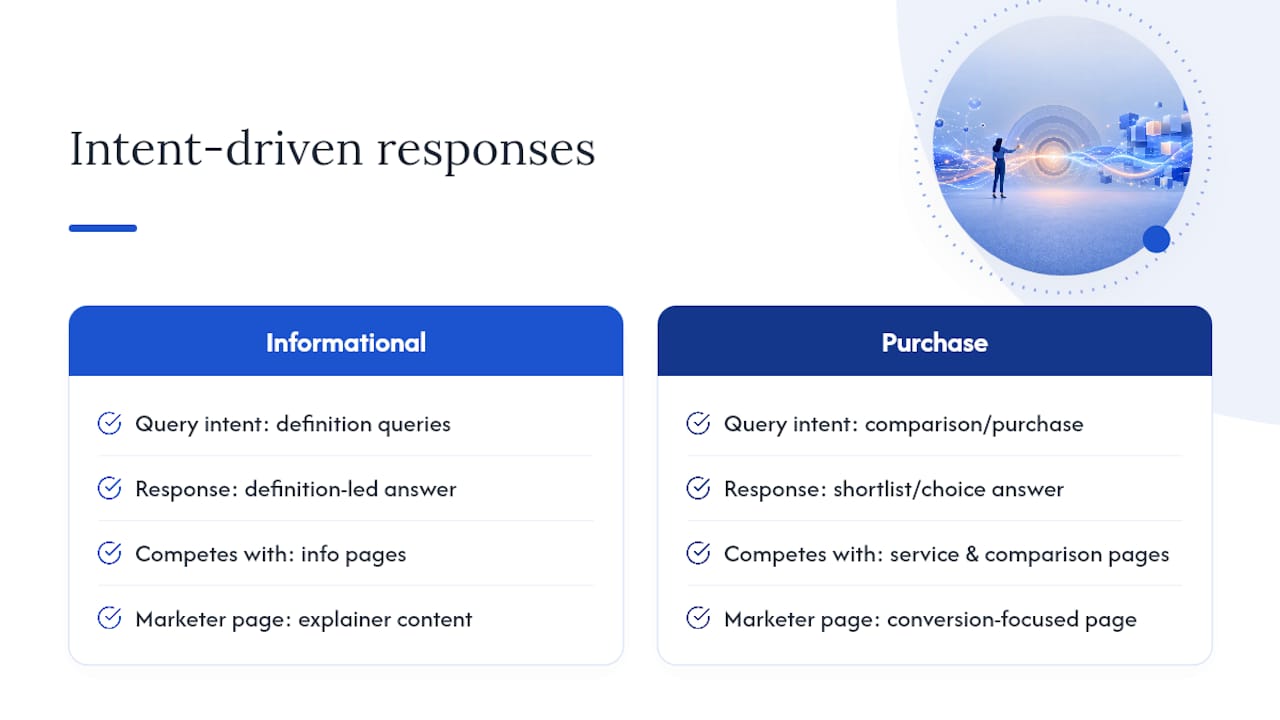
AI-driven search doesn’t just match keywords, it interprets what the searcher is actually trying to achieve, then adjusts the answer to match that stage of their journey. Someone asking “what is AI search optimisation” gets a definition-led response. Someone asking “best web developer for AI-optimised small business sites” gets a shortlist-style answer, because the system has classified that query as comparison or purchase intent.
That classification changes what gets cited. Informational pages compete for the first type of query. Service and comparison pages compete for the second. If your only content is a generic blog post, you’re only in the running for the easier, lower-value query.
Personalisation adds another layer. Signed-in AI assistants increasingly factor in a user’s location, prior searches, and even device type when shaping a response, which mirrors how Google Search has personalised results for years. A small business searching for a website provider will often get local or UK-specific mentions surfaced ahead of global ones, so localised signals on your site (address, service area, UK-specific pricing) genuinely help you get pulled into the right subset of answers.
The lesson for marketers is to build separate content for separate intents rather than one page trying to serve everyone. A page explaining what AI search optimisation is should not be the same page trying to convert a buyer ready to hire someone to do it.
Why does voice search still matter for AI optimisation?
Voice search and conversational AI share the same appetite: they both want a direct, spoken-style answer rather than a wall of text. When someone asks a smart speaker or a voice assistant a question, the system reads out a single answer, usually the top-ranked snippet or the AI-generated summary, with no second or third result to fall back on.
That’s a much higher bar than traditional search, where being on page one was good enough. For voice and conversational queries, you’re either the answer or you’re nowhere.
Writing for this means matching how people actually speak, not how they type. Typed queries tend to be short and clipped (“AI search optimisation checklist”). Spoken queries are longer and more natural (“what’s the first thing I should do to get my site showing up in AI search results”). Structuring your question headings closer to natural speech, and answering them the way you’d explain it to a colleague, tends to serve both formats at once.
Conversational AI assistants extend this further by holding a back-and-forth exchange, refining the answer as the user asks follow-up questions. That rewards content that anticipates the next logical question and answers it nearby, ideally in the next section down, so the assistant can keep pulling from your site through several turns of a conversation rather than switching to a competitor after the first answer.
Why does semantic SEO matter more in an AI-first search world?
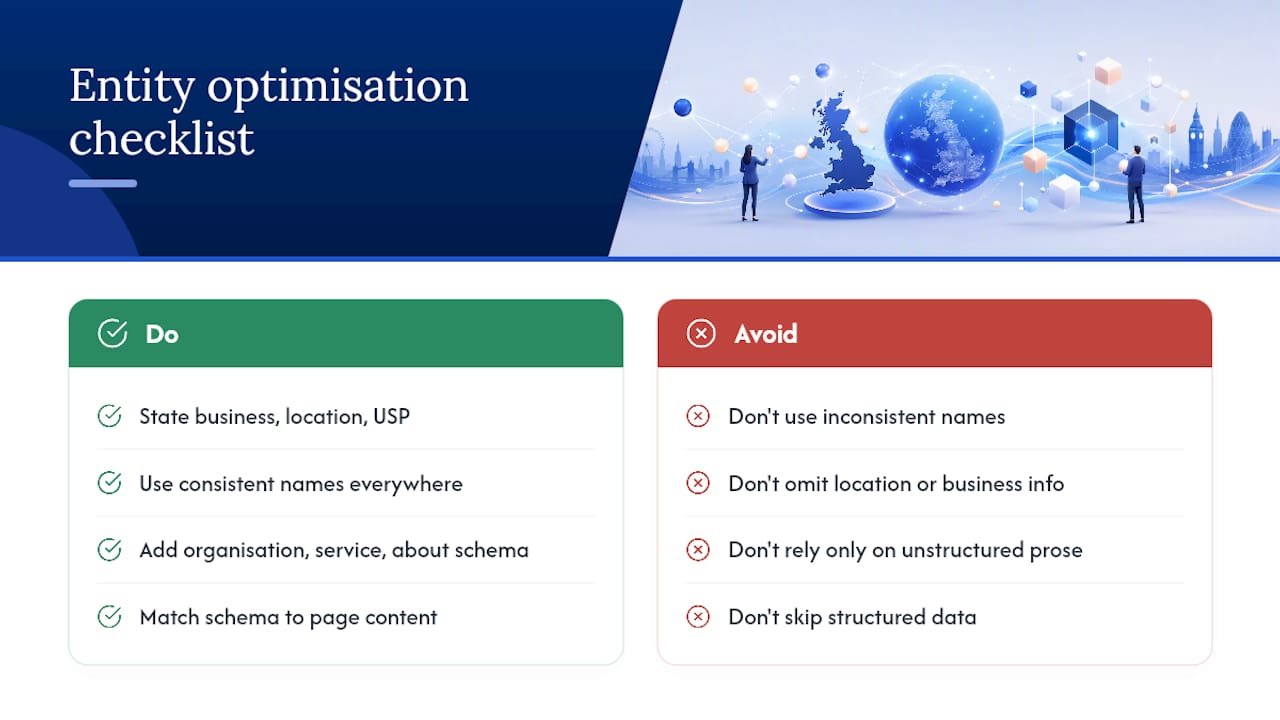
Semantic SEO means writing about a topic in a way that establishes what your business actually is, not just what keywords appear on the page. AI systems build an understanding of entities, meaning specific people, places, businesses, and concepts, and how they relate to each other. If your site never clearly states what you do, where you operate, and what makes you distinct, the model has nothing solid to attach to your name.
Entity optimisation is the practical side of this. It means using consistent naming for your business across your site, your schema markup, and your third-party listings, so an AI system can confidently link the mentions together into one coherent profile rather than treating them as unrelated fragments.
This is where a lot of small business sites quietly fail. A site that calls itself one thing in the header, another in the footer, and something slightly different again on its Google Business Profile is handing the AI system a puzzle instead of an answer. Consistency is not glamorous work but it makes a measurable difference to whether a system trusts what it’s reading.
Structured data plays directly into this. Organisation schema, service schema, and clear “about” content all give an AI system explicit labels for the entities on your page, rather than forcing it to infer them from unstructured prose. It’s the difference between telling a system exactly who you are and hoping it works it out on its own.
How should you optimise images and video for AI search?
Multimedia content gets read differently by generative systems, and most sites still treat it as an afterthought. Alt text remains genuinely useful here, not because Google mandates it, but because it’s often the only textual signal an AI system has for what an image actually shows. A vague “team photo” alt tag tells an assistant nothing; “Basic-bs web developer reviewing a client site mockup” gives it something concrete to work with.
Video is trickier, since most AI crawlers can’t watch a video the way a person can. Transcripts solve this directly. A full, accurate transcript published alongside a video turns an otherwise opaque asset into fully extractable text, which is why sites that pair video with a written summary or transcript tend to show up in AI answers far more than video-only pages.
Filenames matter more than people assume too. An image saved as IMG_4021.jpg carries no information; one saved as basic-bs-website-design-mockup.jpg does. It’s a small habit, but it costs nothing and consistently helps.
Captions and structured metadata (schema for VideoObject or ImageObject) round this out by giving AI systems explicit, machine-readable context rather than leaving them to guess from surrounding text. None of this replaces strong written content elsewhere on the page, but it stops your visual assets being dead weight that a generative system simply skips over.
Where is AI search technology heading next?
The pace of change here isn’t slowing down, and betting on today’s exact rules staying fixed would be a mistake. Multimodal search, where a system reads text, images, and video together to form one answer, is already appearing in early form across major platforms, which raises the stakes on the multimedia optimisation covered above.
Real-time retrieval is also becoming more common, with systems pulling live data rather than relying solely on a cached index. That rewards sites that keep content genuinely current rather than publishing once and forgetting it, since a system checking live sources will simply skip a page that hasn’t been touched in years.
Expect verification to tighten too. As more content on the web gets generated by AI itself, the systems doing the citing will likely lean harder on verifiable, sourced, dated claims to avoid citing something another AI already made up. That plays directly into the evidence-based approach covered earlier in this guide, and it’s likely to matter more, not less, over the next couple of years.
None of this means starting again every few months. It means building the habits already covered here (clear structure, technical access, real evidence) as a standing practice rather than a one-off project.
How does Basic-bs put AI search optimisation into practice?
Every site we build gets AI training baked in from day one, not bolted on afterwards as an upsell. That means server-side rendering so crawlers can actually read the page, schema that correctly labels what’s on it, and answer blocks written to be lifted, not buried in marketing waffle. We handle the technical build, AI training, SEO, and UK hosting as one job, because splitting it across three suppliers is usually how things go wrong. If you’d rather understand the risks first, our piece on why cheap website builds tend to fail covers exactly where the corners get cut. Whether you handle this in-house or bring in someone to do it properly depends on how much time your team genuinely has spare.
— Conor
Get a website built to be found by AI, not just Google
We offer an alternative to agency quotes with long timelines and high invoices. Sites are built live within a week, with AI search optimisation incorporated from the start rather than sold later as an add-on.
No upfront costs, no hidden fees, plans from £39.99 a month, and every site built with the crawlability and structure this whole guide has walked through. Have a look through our website examples to see the standard, then check out our services page to see exactly what’s included before you get a quote.
Sources
- Optimizing your website for generative AI features on Google Search | Google Search Central
- Optimizing your content for inclusion in AI search answers — Microsoft Ads blog
- SEO in 2026: How AI is reshaping the fundamentals of search | Adobe